

What’s Happening This Week in Reproductive Freedom for All
Reproductive freedom is being shaped this week by what happens in emergency rooms, who can reach a clinic, how federal family-planning dollars are distributed, and what voters put into their state constitutions.
And behind all of it are real people trying to make deeply personal decisions about their bodies and healthcare.
The family of a Texas woman who died during pregnancy has filed a lawsuit alleging that the state’s abortion ban contributed to delays in the care she needed.
A federal judge dismissed a challenge to major changes in how the federal government plans to distribute Title X family-planning money.
New national data show that 21.4 million women who need low- or no-cost contraception live in counties where the availability of publicly funded care falls short of the need.
And in Nevada, voters are preparing to decide for a second time whether abortion protections should be written directly into the state constitution.
Different stories. Different parts of the country.
But the same reality keeps surfacing: reproductive healthcare is not determined by medicine alone.
It is also being shaped by laws, courts, government funding, geography, and whether a provider believes they can safely give a patient the care they need.
❤️ When the Law Enters the Exam Room
🕯️ A Texas Family Says the Abortion Ban Contributed to a Mother’s Death
Tierra Walker was 37 years old, a mother, and 20 weeks pregnant when she died from severe preeclampsia in December 2024.
Now her family has sued Texas Attorney General Ken Paxton, state medical officials, physicians, and the University of Texas Health Science Center. The lawsuit alleges that Walker needed an abortion as her condition worsened but that doctors did not provide one despite the medical-emergency exception in Texas law.
The defendants have not yet had the case adjudicated, so the family’s claims remain allegations. But the lawsuit puts a question that has followed abortion bans since Dobbs directly before a court: what happens when doctors must weigh a patient’s deteriorating medical condition against the possibility of legal consequences for ending a pregnancy? Reuters
Why it matters: An exception written into a law matters only if patients and doctors can understand when it applies and use it in an emergency. This case could test how those exceptions operate when the stakes are measured in minutes, hours, and lives.
🏥 A Challenge to New Title X Rules Was Dismissed
A federal judge in Pennsylvania dismissed a lawsuit challenging changes to the government’s 2027 Title X grant process.
Title X supports family-planning services for many low-income and uninsured patients, including contraception, pregnancy testing, STI testing and treatment, and preventive health visits. Federal Title X dollars cannot pay for abortion.
The organizations that sued argued that the new grant process improperly tied funding to administration priorities. U.S. District Judge Jennifer P. Wilson dismissed the case after finding that the plaintiffs had not demonstrated sufficiently concrete harm at this stage. The new funding process therefore remains in place for now. Stateline
Why it matters: Reproductive healthcare can become harder to obtain without a single clinic being formally banned from providing it. Funding rules help determine which organizations can keep their doors open, what services they can afford to provide, and which communities can reach them.
💊 21.4 Million Women Live Where Affordable Birth Control Access Falls Short
A new county-by-county analysis provides a startling picture of contraception access in America.
Researchers found that 21.4 million women of reproductive age who need low- or no-cost contraception live in counties with a contraceptive access gap.
Among them, 15.7 million live in counties where available services meet no more than one-quarter of estimated need. More than 1 million live in counties without a single publicly funded health center offering contraceptive care, while 1.9 million live in counties without a publicly funded health center offering the full range of birth-control methods. GBP
Why it matters: Having the legal freedom to use contraception and actually being able to obtain it are two different things. Cost, distance, transportation, clinic capacity, privacy, and available methods can all determine whether reproductive choice exists in practice.
🗳️ Nevada Will Vote on Abortion Protections Again
Nevada voters will again consider Question 6 this November.
The measure would make abortion a fundamental right under the Nevada Constitution through fetal viability, with later care permitted when necessary to protect the pregnant patient’s life or health.
Nevada voters already approved Question 6 in 2024 with about 64% support. Because it is a citizen-initiated constitutional amendment, Nevada law requires voters to approve it a second time before it can become part of the state constitution.
Abortion is currently protected in Nevada by state law through 24 weeks, with later abortions permitted when a physician determines the patient’s life or health is at risk. This is Reno
Why it matters: Since Dobbs, state constitutions have become an increasingly important part of the legal landscape surrounding reproductive healthcare. Nevada voters will determine whether their existing statutory protections also receive constitutional protection.
💔 Why This Matters
Reproductive freedom does not live in only one Supreme Court opinion, one abortion clinic, or one piece of legislation.
It lives in the emergency room when a pregnancy becomes dangerous.
It lives in whether someone working two jobs can find affordable contraception nearby.
It lives in whether a community health center has enough funding to remain open.
It lives in whether a physician knows exactly what care the law allows before a patient’s condition becomes critical.
And it lives in the difference between a right written on paper and healthcare someone can actually obtain.
This week’s stories show how many layers stand between a patient and care: medical judgment, hospital policies, state law, federal funding, clinic capacity, geography, courts, and elections.
Understanding those layers matters because reproductive-health policy ultimately becomes something much more tangible.
A doctor’s decision.
A clinic appointment.
A prescription.
An emergency.
A person sitting in an examination room waiting to learn what happens next.
💚 Good News Worth Carrying With You
Researchers published encouraging new evidence this week about something patients have complained about for years: pain during IUD insertion.
In a randomized clinical trial involving 370 participants who had not previously given birth, researchers tested the local anesthetic mepivacaine during IUD placement.
Average pain scores were significantly lower among patients who received mepivacaine than among those who received a placebo, and researchers concluded that the technique could offer a relatively simple way to improve the IUD-placement experience. The study reported no serious adverse events, although the researchers noted that the treatment was not compared with other pain-management approaches. Jama Network
Pain should not simply be dismissed as something patients are expected to endure.
Better evidence can lead to better care.
And that matters too.
📣 Take Action This Week
The new contraception-access data are interactive, which means you can see what access looks like where you live.
Check the map. Find the clinics around you. Save the information somewhere you can find it again. One minute spent learning where care is available today could matter to you, a friend, a neighbor, or someone in your family tomorrow. Can’t find care in your area? Support Reproductive Freedom groups doing the work to expand access: Bans Off Our Bodies
👀 What We’re Watching
The Tierra Walker case: The lawsuit is newly filed. Watch for responses from the state, physicians, and healthcare institutions, along with any rulings about whether the family’s constitutional and emergency-care claims can proceed.
Title X funding: The court dismissed this challenge, but the 2027 grant process continues. The next question is how the revised funding criteria affect applicants, providers, and ultimately patients who rely on publicly funded family-planning services.
Nevada Question 6: Voters will make the second and final decision on the proposed constitutional amendment on November 3.
The contraception-access gap: The new map gives us something previous national numbers often could not: a county-level look at where need and available services do not line up. That makes it worth watching what happens next in the communities with the largest gaps.
❤️ One Thing to Carry With You
Reproductive healthcare is not an abstract debate.
It is a woman with preeclampsia waiting for doctors to decide what they can legally do.
It is someone searching for affordable birth control and discovering the nearest clinic cannot meet the demand.
It is a patient bracing for an IUD insertion and asking whether anyone has taken their pain seriously.
It is a physician trying to practice medicine while also navigating statutes, regulations, hospital lawyers, funding restrictions, and court decisions.
And sometimes it is voters reading a few lines on a ballot that could shape state law for years.
That is why the details matter.
Read beyond the slogans. Ask what a law actually does. Ask whether an exception actually works. Ask whether a legal right can actually be accessed. Ask what happens to the patient when policy leaves the page and enters the examination room.
Because eventually every reproductive-health policy becomes personal for someone.
And that person deserves to be seen.
Our freedom has never survived because powerful people generously handed it to us.
It survives because people defend it.
And we are still here.
Laurie Woodward Garcia
(paid with hugs and kisses, not bought by special interests)
Leader, People Power United
People Power United | In this community, we speak out, show up, and build power against racism, xenophobia, Islamophobia, antisemitism, homophobia, misogyny, sexism, ageism, ableism, sizeism, elitism, transphobia, misogynoir, and bigotry.
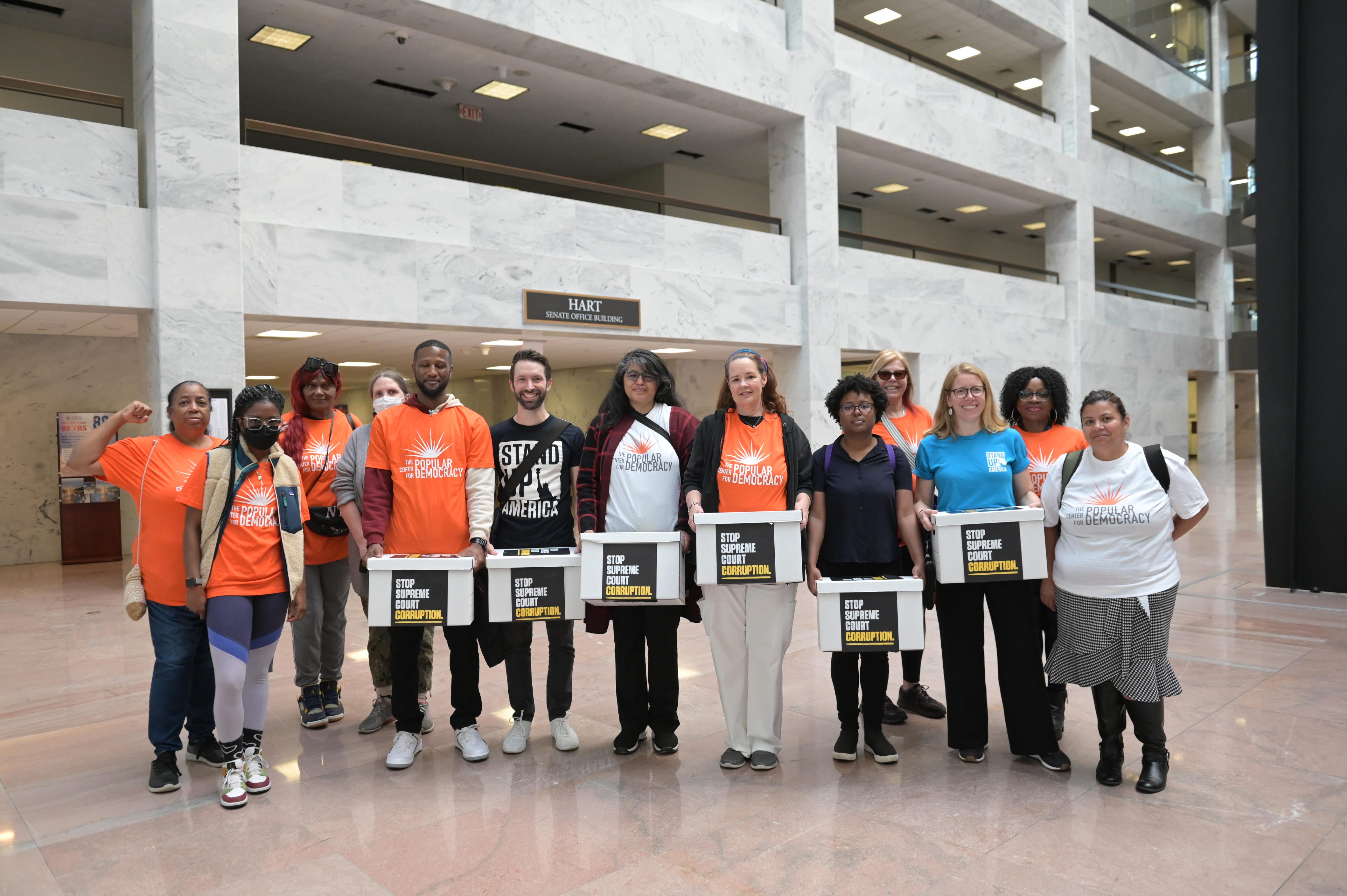
This is our moment to rise, resist, and reclaim our rights, freedoms, rule of law, and democracy. Millions of Americans are already refusing to back down — in the streets, at the ballot box, and in their communities.
Every movement that was ever won started with people who refused to quit. We are those people.
The future is not lost. It is being built — by us, right now.
Absolute shameful insanity...I wonder whether a man would be expected to "wait" for treatment until his penile pain became "life threatening." I hope that every single woman who experiences pain and death from these monstrous regulations...and her family...will sue every singe pro-abortion politician and zealot for everything they own, try and convict and incarcerate them for assault and murder, and finally remove and put up for adoption any unfortunate child these psycho monsters may have spawned.