



Reproductive Freedom for All: The Fight Is Now — Here’s How to Join It
Every day in 2026, reproductive rights hang in the balance — not as a future threat, but as an active, unfolding reality. In Tennessee, lawmakers proposed the death penalty for abortion. In Louisiana, a federal lawsuit is targeting the right to receive abortion medication by mail. And in Zambia, a woman who was denied a legal abortion went to prison for ending her pregnancy in the only way left to her. Real people, real consequences, right now. This is not a series of isolated local disputes. It is a national strategy — and it demands a national response.
Why the Grassroots Resistance Can’t Wait

🔊 Take Action Now — Because Waiting Is Not an Option
The prochoice movement needs you, and it needs you today. Here’s how to show up:
🏥 Take action: Stop attacks on Planned Parenthood and community clinics
🔍 Take action: Demand an investigation into crisis pregnancy centers that mislead patients with inaccurate or incomplete medical information
🛡️ Take action: Oppose attempts to dox abortion patients or expose their medical records to hostile third parties
💚 Take action: Support organizations on the front lines, including Bans Off Our Bodies and your local abortion fund
🗳️ Bonus action: Register to vote, vote in every election, and help your community do the same. Reproductive freedom is won and lost at the ballot box.
👑 Bonus action: Sign up for the next national No Kings Day of Action and show up in solidarity with everyone whose rights are under attack.

What’s Happening: Three Stories Exposing the Coordinated Attack on Reproductive Rights
The assault on reproductive justice rarely announces itself plainly. It arrives disguised as a procedural motion, a state legislative bill, or a funding rule applied in a quiet new context. Each story looks local. Together, they reveal a national playbook — and it is dangerous.
⚖️ Tennessee Tried to Make Abortion a Death-Penalty Offense — and It’s Not Over
Two Tennessee Republican legislators pushed an amendment that would have applied the state’s full homicide framework to abortion — from fertilization forward — making anyone who obtains, performs, or assists with an abortion eligible for murder charges and, in some cases, the death penalty. The amendment contained no exceptions for rape or incest. It failed in the House Population Health Subcommittee on March 10, 2026 — but sponsor Rep. Jody Barrett called the outcome a failure of Republican principles, and said similar legislation is advancing across the country. The Hill
Why This Matters: The death penalty for abortion is the loudest version of this attack — designed to shift the Overton window and make the quieter bills look reasonable by comparison. Barrett said the momentum is building. He’s right that similar bills are spreading. Defeating the loudest version is not the end of the fight. It’s the beginning of the next one.
🌍 This Is What Criminalization Looks Like: Violet Zulu’s Story
Violet Zulu, a 26-year-old mother and house cleaner in Zambia earning $40 a month, was denied a legal abortion at a public clinic and couldn’t afford the $43 cost of medication at a private pharmacy. In desperation, she ended her pregnancy using an herbal remedy. She was sentenced to seven years in prison, represented herself in court without understanding the legal consequences, and was separated from her two children for nearly two years. After international rights groups intervened and helped her appeal, she was freed — but she is still rebuilding her life. Seattle Times
Why This Matters: Violet Zulu’s story is not a foreign policy issue. It is a warning about what happens when abortion is criminalized and poverty determines outcomes. The person who cannot afford care becomes the person who goes to prison. That is the design. That is the destination every “homicide” bill points toward.
💊 Louisiana’s Lawsuit Could End Telehealth Abortion Nationwide
Louisiana Attorney General Liz Murrill — backed by 60 Republican members of Congress, 21 GOP attorneys general, and major anti-abortion organizations — is pursuing a federal lawsuit seeking to reinstate the in-person dispensation requirement for mifepristone, which would effectively ban abortion pills from being prescribed via telehealth or mailed to patients. Nearly 30% of all abortions in the first half of 2025 were provided through telehealth. About 15,000 abortions per month are currently provided by physicians protected by shield laws in states where the procedure is legal. Sen. Josh Hawley has simultaneously introduced a bill to revoke FDA approval of mifepristone entirely. Truthout
Why This Matters: Telehealth abortion is not a convenience feature — it is a lifeline for patients in rural areas, low-income communities, and states where in-person care has been eliminated. Reinstating the in-person requirement doesn’t stop abortions for people who can travel. It stops them for everyone else. That is the point.

Why This Is Not a Values Debate — It’s a Fight for Bodily Autonomy
When Rep. Jody Barrett proposed applying Tennessee’s homicide framework to abortion — including the death penalty — he wasn’t articulating a values position. He was attempting to use criminal law to execute people for a medical decision. The bill failed, but identical legislation is advancing across multiple states. The tools shift. The goal doesn’t. The Louisiana mifepristone lawsuit is the quieter version — technical, targeted, and still advancing. It doesn’t send anyone to prison directly. It simply removes the only abortion option available to the person in a rural county, the person without a car, the person who cannot travel. Violet Zulu tried every legal option, found every door closed, and spent two years in maximum-security prison. That is not a hypothetical. That is the documented, predictable consequence of criminalization applied to poverty.
💔 Why These Stories Matter
These policies do not harm everyone equally. That asymmetry is a design feature. Low-income patients, rural residents, people of color, and immigrants absorb the greatest consequences — every time. And yet the reproductive justice movement is not waiting to be legislated out of existence. Shield laws are holding. Rights groups fought for Violet Zulu across international borders and won. Ballot initiatives to protect abortion access have passed in multiple states since Roe fell. When voters get a direct say on reproductive freedom, they vote to protect it. Every time. Step back and the shape becomes clear: Tennessee’s death-penalty bill, Louisiana’s telehealth ban, Zambia’s prison sentence — these are the coordinated outputs of a single strategy. When you cannot determine what happens to your own body, you haven’t just lost a healthcare benefit. You’ve lost a form of political agency. Reproductive freedom and democratic freedom are not two separate causes. They are the same cause — and People Power is that movement.
What Comes Next: The Women’s Health Protection Act
The path forward is through the courts, the ballot box, and Congress — and there are concrete legislative tools available right now.
The Women’s Health Protection Act: A Federal Shield for Abortion Rights
The Women’s Health protection Act (WHPA) would establish a federal statutory right to provide and access abortion care — one that cannot be overridden by state-level bans or restrictions. Under former Leader Pelosi, it has already passed the House. It is currently blocked in the Senate by Republican opposition.
What the WHPA does:
Protects abortion access nationwide with a binding federal statutory guarantee
Prevents state bans from interfering with the patient-provider relationship
Restores bodily autonomy as a legally enforceable right — not merely a precedent subject to reversal
Has already passed the House; blocked by Republicans in the U.S. Senate
Passing the WHPA requires electing senators who will vote for it — which means registering voters, turning out voters, and building the sustained civic infrastructure that converts political will into electoral outcomes. That work is already happening, and it is making a measurable difference.
⚖️ Take action: Urge your members of Congress to co-sponsor and support the Women’s Health Protection Act
Together, we can champion our rights, freedoms, and democracy, hold our leaders accountable to the people’s will, and inspire voters to make a meaningful difference.
Laurie Woodward Garcia (paid with hugs and kisses, not bought by special interests) Leader, People Power United
People Power United | In this community, we will always speak out against racism, xenophobia, Islamophobia, antisemitism, homophobia, misogyny, sexism, ageism, ableism, sizeism, elitism, transphobia, misogynoir, and bigotry!
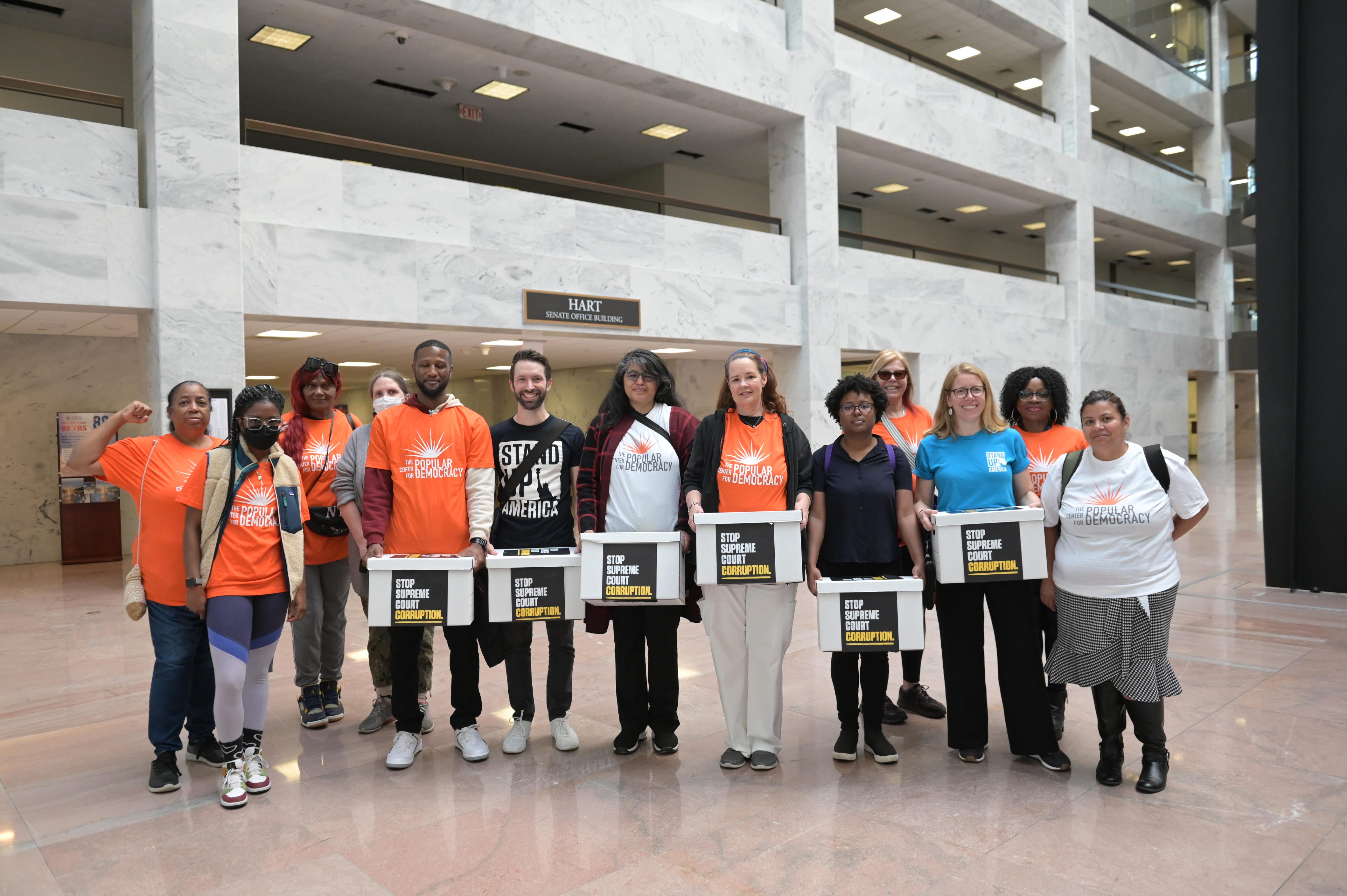
This is our moment to rise, resist, and reclaim our rights, freedoms, rule of law, and democracy. Millions of Americans are already refusing to back down — in the streets, at the ballot box, and in their communities.
Every movement that was ever won started with people who refused to quit. We are those people.
The future is not lost. It is being built — by us, right now.